Consultant-led musculoskeletal care in Oxford
Oxford Injection Clinic is a specialist musculoskeletal (MSK) service based at 14 Elms Parade in Botley, Oxford. We diagnose and treat painful joints, tendons, nerves and soft-tissue problems using consultant-level assessment, real-time diagnostic ultrasound and image-guided injections. Every patient is seen by an experienced MSK clinician who takes time to understand the problem, examine the affected area, review any prior imaging and then agree a clear treatment plan with you before anything is done. There are no production-line appointments here — each consultation is scheduled to give you enough time to ask questions, understand your diagnosis and weigh up the options.
Why patients across Oxfordshire choose us
Persistent joint or tendon pain is exhausting. It disturbs sleep, shortens walks, stops people playing with grandchildren, cutting runs short, or forcing them to give up hobbies they love. Many of our patients arrive after months of over-the-counter painkillers, NHS waiting lists, or advice that hasn't moved things forward. Our role is to shorten that journey: a same-week appointment, an on-the-day scan when it's needed, and a treatment recommendation you can trust. We are proudly part of GB Clinics, a Botley-based healthcare group with a five-star Google rating built from more than eighty-nine verified patient reviews, and we bring the same careful standards to every appointment at the Oxford Injection Clinic.
Diagnostic ultrasound — the reason accuracy matters
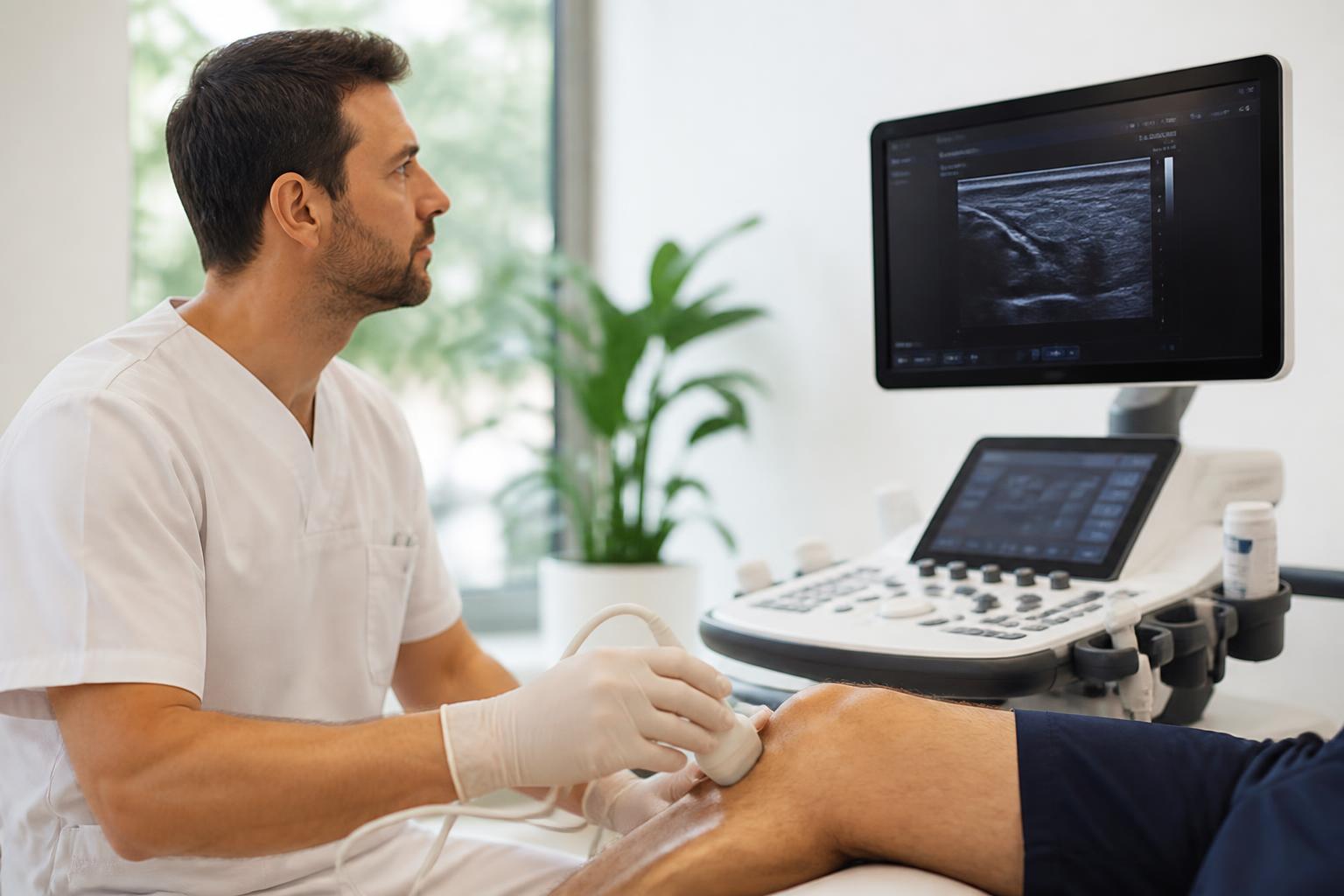
Most joint and tendon pain has more than one possible cause. A painful shoulder might be a rotator cuff tear, a calcific tendon, bursitis, an early frozen shoulder, or referred pain from the neck. A painful knee might be osteoarthritis, a meniscal problem, patellar tendinopathy, or a Baker's cyst. Physical examination alone can narrow the list, but modern MSK ultrasound lets us look inside the joint in real time — watching tendons glide, spotting fluid, calcium deposits, tears and inflammation, and comparing side-to-side in a matter of minutes. That means treatment is matched to what is actually happening, not to a best guess. It also means we can be honest when an injection is unlikely to help and refer you on for the intervention that will.
When an injection is the right next step, ultrasound guides the needle to the exact target — the bursa, the tendon sheath, the joint space or the nerve — under live imaging. Studies consistently show that ultrasound-guided injections are more accurate than landmark ("blind") injections, especially at the shoulder, hip, wrist and small joints of the foot. Better accuracy means a better chance of lasting relief and less collateral irritation of nearby tissue.
Treatments we offer under one roof
Our clinicians perform ultrasound-guided steroid injections for shoulder impingement, subacromial bursitis, tennis and golfer's elbow, De Quervain's tenosynovitis, trigger finger, carpal tunnel syndrome, hip bursitis (greater trochanteric pain syndrome), knee osteoarthritis, plantar fasciitis and Morton's neuroma. For knees and other large joints we also offer hyaluronic acid (viscosupplementation) injections such as Ostenil, Durolane and Arthrosamid — a longer-lasting polyacrylamide hydrogel option for osteoarthritic knees where steroids are no longer suitable. Where regenerative treatment is appropriate we provide platelet-rich plasma (PRP) injections for tendinopathies and early cartilage wear.
Alongside injections we run barbotage for calcific tendonitis of the shoulder, hydrodilatation for frozen shoulder, radial shockwave therapy for chronic tendon pain, and trigger-point injections for stubborn myofascial pain. Consultant-led spinal injection referrals are arranged through our sister service when the source of the pain is coming from the neck or back rather than the peripheral joint.
What to expect at your appointment
Please arrive a few minutes early with any relevant scans, GP letters or medication lists. Wear clothing that gives easy access to the affected area — shorts are useful for knee and hip appointments, a vest top for shoulders. The consultation begins with a detailed history: how the pain started, what makes it worse, what you have already tried and how it is affecting daily life. This is followed by a physical examination and, where indicated, a diagnostic ultrasound scan. We then talk through the findings on-screen, explain the likely diagnosis in plain language, and discuss all reasonable options — including doing nothing, continuing physiotherapy, or proceeding with an injection or scan-guided procedure. If you choose to have an injection on the same day it is usually completed within a few minutes; most patients drive themselves home immediately afterwards.
After your injection
Steroid injections typically take between two and seven days to start working, with peak effect around two to four weeks. Some patients feel a short-lived flare-up of discomfort in the first twenty-four hours as the local anaesthetic wears off — a warm compress and simple analgesia usually settle this. Hyaluronic acid injections work more gradually, with benefit building over four to six weeks and often lasting six to twelve months. We send every patient home with clear written aftercare advice, a direct phone number to reach the clinic, and, where useful, a personalised rehabilitation programme delivered by our physiotherapy team. A follow-up review is offered six weeks after your procedure so we can measure your progress objectively and plan the next stage of care.
Safety, governance and referral pathways
Every clinician at Oxford Injection Clinic is fully registered with their professional body, insured for the procedures they perform, and works to nationally recognised MSK standards. We keep clear records, audit our outcomes, and only recommend treatments that the current evidence supports. When a problem falls outside the scope of injection therapy — for example a surgical rotator cuff repair, a knee replacement, a spinal decompression or an inflammatory arthritis — we arrange a prompt onward referral to a trusted local consultant so that no time is wasted. Our aim is straightforward: the right treatment, at the right time, delivered as safely as possible, so that you can get back to the activities that matter to you.
Booking, location and getting in touch
You do not need a GP referral to be seen at Oxford Injection Clinic. Most patients self-refer directly by phone on 01865 317483 or by using the online booking form on this website. We are located at 14 Elms Parade, Botley, Oxford OX2 9LG, with free patient parking directly outside the clinic and step-free access from the pavement. Elms Parade is easily reached from the A34, the Oxford ring road and central Oxford, and is served by frequent bus routes from Cowley, Headington, Kidlington, Abingdon and Witney. Whether you are a local resident, a university student, a visiting patient from further afield or a professional based in Oxford Science Park or Milton Park, our team looks forward to helping you move better, feel better and live better.
Conditions we commonly treat
Shoulder problems make up a large share of our workload. We see patients with rotator cuff tendinopathy and partial-thickness tears, subacromial impingement, calcific tendonitis, adhesive capsulitis (frozen shoulder), acromioclavicular joint arthritis and glenohumeral osteoarthritis. Depending on the diagnosis, treatment might involve an ultrasound-guided subacromial injection, barbotage of a calcium deposit, hydrodilatation for frozen shoulder, or referral for surgical opinion when conservative options have been exhausted.
At the elbow we treat lateral epicondylitis (tennis elbow), medial epicondylitis (golfer's elbow), distal biceps tendinopathy and olecranon bursitis. Wrist and hand problems include De Quervain's tenosynovitis, trigger finger, carpal tunnel syndrome, thumb-base (CMCJ) osteoarthritis and ganglion cysts — each of which responds well to targeted ultrasound-guided injection when clinically appropriate.
Around the hip we see greater trochanteric pain syndrome, gluteal tendinopathy, iliopsoas irritation and hip osteoarthritis. At the knee we manage osteoarthritis, patellar tendinopathy ("jumper's knee"), iliotibial band syndrome, pes anserine bursitis and Baker's cysts. Foot and ankle referrals include plantar fasciitis, Achilles tendinopathy, Morton's neuroma, tarsal tunnel syndrome and first metatarsophalangeal joint arthritis. Whatever the region, our diagnostic-first approach ensures we understand the mechanical picture before recommending any injection.
Working alongside your GP, physio and consultant
We view ourselves as a collaborative link in your wider care team, not a replacement for it. With your permission we send a concise clinic letter to your GP after every appointment, summarising the diagnosis, any scan findings and the treatment plan. If you are working with a physiotherapist elsewhere we are happy to share exercise progressions and injection timing so that rehabilitation continues seamlessly. Where a surgical opinion is likely to be useful we work with a small group of Oxford orthopaedic and rheumatology consultants whose practice we know well, and we can usually organise a same-week referral if that is what the situation requires.
Evidence and outcomes
Every treatment we offer is supported by peer-reviewed evidence and reflects current UK and international guidelines. Ultrasound-guided steroid injections have repeatedly been shown to be more accurate than blind injections, with better short-term pain relief for shoulder impingement, hip bursitis and small-joint arthritis. Radial shockwave therapy is recommended by NICE for chronic plantar fasciitis, refractory Achilles tendinopathy and calcific rotator cuff disease. Hyaluronic acid viscosupplementation for knee osteoarthritis has a well-established role for patients who cannot tolerate NSAIDs or wish to postpone surgery. We monitor our own outcomes with a validated patient-reported outcome measure at six weeks and again at six months, so we can be transparent with you and with referrers about what our treatments really deliver.
Pricing and insurance
Transparent pricing is one of the founding principles of the clinic. Every consultation includes a full history, examination and — where indicated — a diagnostic ultrasound scan at no additional charge. Injection procedures are quoted up front, with the cost of the medication itself included in the price so there are no surprise add-ons. Detailed pricing for each treatment is available on our dedicated pricing page. We welcome self-pay patients and can provide detailed invoices suitable for insurance reimbursement claims. If you plan to claim through an insurer, please check your policy details with them first and bring any authorisation or membership details to your appointment.
Common questions before booking
Do the injections hurt? Almost every injection is preceded by local anaesthetic, and the needles we use for the treatment itself are very fine. Most patients describe the sensation as a brief pressure rather than sharp pain. Because we can see exactly where the needle is going on ultrasound, there is no repeated repositioning — the procedure is usually over in under a minute.
How long will the relief last? This depends on the diagnosis. A steroid injection into a bursa or tendon sheath often gives symptom relief for three to six months, and for many patients that window is enough to complete a rehabilitation programme and return to normal activity. In osteoarthritis, hyaluronic acid injections tend to last longer than steroids, typically six to twelve months. We will always give you an honest estimate for your specific problem.
Can I drive home? Yes, in almost every case. Peripheral joint injections do not affect your ability to drive, and there is no sedation involved. We suggest taking things gently for twenty-four hours afterwards, but there is no need to book time off work for a routine injection.
What if the injection doesn't work? We tell every patient at consultation what the realistic response rate is for their specific diagnosis, and we plan for the possibility of a non-responder from the outset. If symptoms have not improved by the six-week review we reassess the diagnosis with a repeat scan if appropriate, discuss alternative treatments such as PRP, hydrodilatation or shockwave, and — where surgery is the more sensible route — arrange a prompt onward referral to a trusted local consultant.