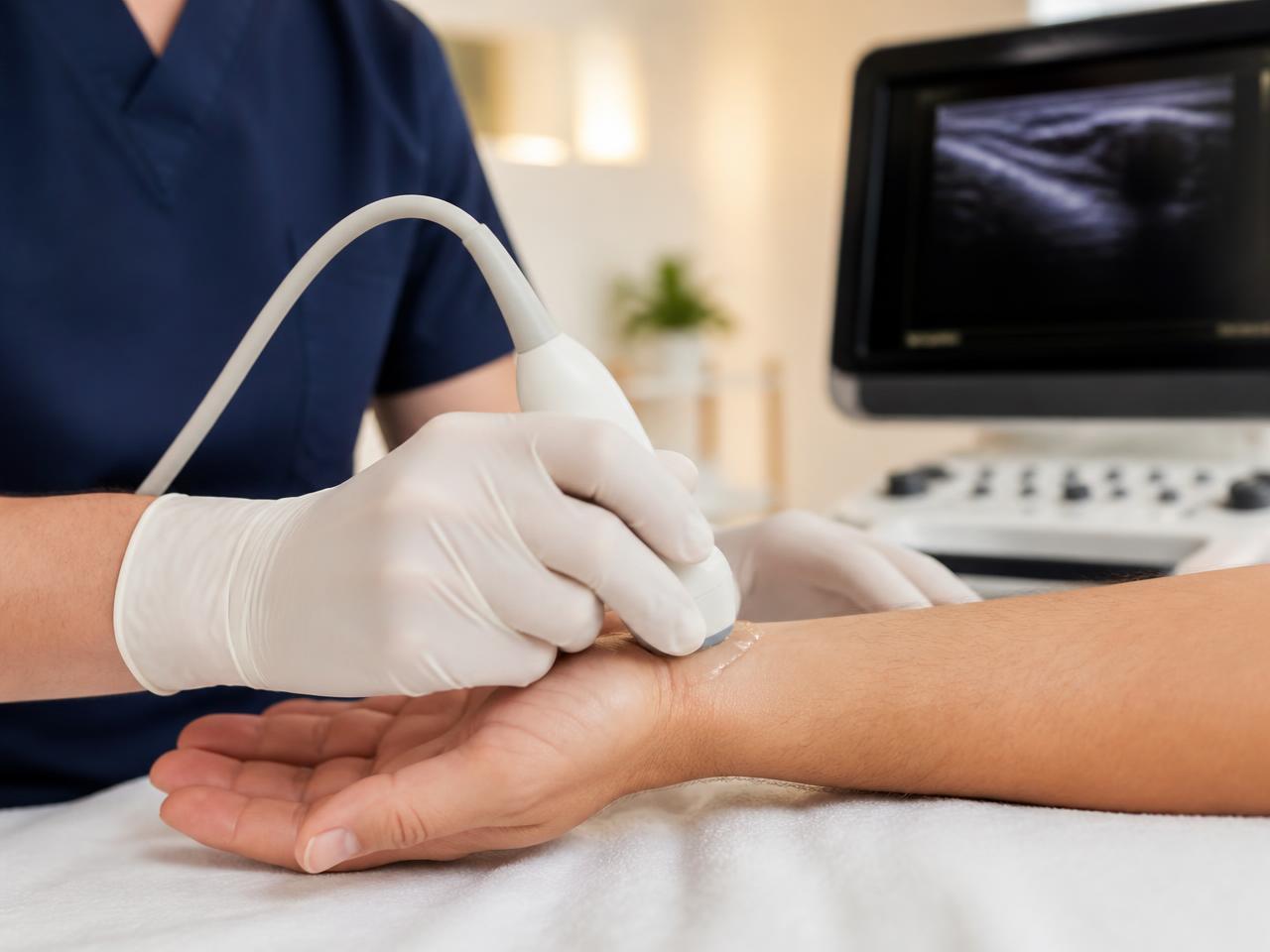
Specialist ultrasound assessment and targeted injection treatment for selected joint and soft-tissue inflammation associated with rheumatoid arthritis, psoriatic arthritis, gout and other inflammatory musculoskeletal conditions.
If one or more joints have become painful, swollen or difficult to move, ultrasound may help identify whether active inflammation is present and guide treatment to the affected area.

Inflammatory rheumatological conditions can sometimes cause an individual joint, tendon sheath or bursa to become particularly painful or swollen. This may occur even when a patient is already under the care of a GP or rheumatology team.
At GB Clinics, we provide specialist musculoskeletal ultrasound to assess the symptomatic area. Where clinically appropriate, a local ultrasound-guided corticosteroid injection may be offered to reduce inflammation within a specific joint, tendon sheath or bursa.
Our service is designed to complement your existing rheumatology care. It does not replace medical assessment, blood tests, medication review or disease-modifying treatment prescribed by your GP or consultant rheumatologist.
Please bring relevant clinic letters, medication details, recent blood-test results and previous imaging reports to your appointment where available.

Ultrasound may identify joint inflammation and certain features associated with crystal deposition. In selected patients with an established or clinically assessed gout flare, aspiration or a local joint injection may be considered.
A new hot, red or severely painful joint must be carefully assessed to exclude infection before any steroid injection is considered.
Musculoskeletal ultrasound provides real-time assessment of joints, tendon sheaths, bursae and surrounding soft tissues.
Other symptomatic joints may also be assessed following clinical review.
Ultrasound findings must be interpreted alongside the patient's symptoms, clinical examination, blood results and rheumatology history. A normal ultrasound does not exclude every inflammatory rheumatological condition.

When inflammation is concentrated within a particular joint, tendon sheath or bursa, a local corticosteroid injection may help reduce pain, swelling and stiffness.
Ultrasound guidance allows the clinician to visualise the target and place the medication accurately while avoiding nearby structures where possible.
A steroid injection is used to manage inflammation in a particular area. It does not cure the underlying rheumatological condition or replace disease-modifying medication.
We discuss your symptoms, rheumatological diagnosis, current medication, previous injections, allergies and relevant medical history.
The symptomatic joints and surrounding structures are examined using diagnostic musculoskeletal ultrasound. Power Doppler may be used when clinically appropriate.
The ultrasound findings and available treatment options are explained clearly. If an injection is unsuitable, alternative advice or onward medical review may be recommended.
If clinically appropriate and informed consent is obtained, aspiration or injection may be undertaken during the same appointment. A clinical report and aftercare advice will be provided.
Same-day treatment is not guaranteed. Treatment depends on the ultrasound findings, clinical assessment, medication history and exclusion of contraindications.
An injection will only be offered after an appropriate clinical assessment. It may need to be delayed or avoided where there is:
Please do not stop anticoagulants, steroids or rheumatology medication unless instructed by the clinician responsible for prescribing them.
Please seek urgent medical assessment rather than booking a routine clinic appointment if you have:
These symptoms can require urgent investigation to exclude joint infection or other serious conditions.
Your assessment will be undertaken by Boobala “Bob” Chandran Subramanian, an Advanced Physiotherapy Practitioner and MSK Diagnostic and Interventional Sonographer.
Bob has worked in musculoskeletal and rheumatology ultrasound since 2012 and has experience in NHS rheumatology ultrasound services, one-stop rheumatology clinics and ultrasound-guided injection procedures.
Where findings suggest uncontrolled systemic disease, infection or the need for medication review, patients will be advised to contact their GP or rheumatology team.
No. Patients can book directly. However, please bring relevant rheumatology letters, blood-test results, medication details and previous imaging reports where available.
Ultrasound can identify features that may support or exclude active inflammation in the examined area, but rheumatoid arthritis cannot be diagnosed from an ultrasound scan alone. Diagnosis requires consideration of symptoms, examination, blood tests and specialist medical assessment.
It may be possible when the diagnosis is clear, the treatment is clinically appropriate and there are no contraindications. Same-day injection cannot be guaranteed.
A local steroid injection may reduce inflammation in a specific joint, tendon sheath or bursa. It does not cure rheumatoid arthritis, psoriatic arthritis or gout and does not replace disease-modifying medication or ongoing rheumatology care.
A local joint injection may be considered for selected patients following clinical assessment, particularly when the diagnosis is already established. A new hot, red or severely painful joint may require urgent investigation to exclude infection before steroid treatment.
PMR generally requires systemic steroid treatment and medical monitoring through a GP or rheumatology specialist. Ultrasound may assess associated shoulder or hip inflammation. A local injection would only be considered for an appropriate focal musculoskeletal problem and is not a replacement for systemic PMR treatment.
The service primarily assesses the hands, wrists, feet and ankles. Other peripheral joints, tendons and bursae can also be assessed following clinical review.
Yes. A clinical ultrasound report will be provided and can be shared with your GP, physiotherapist or rheumatology team.
This depends on the medication, dose, procedure and individual risk. Do not stop blood-thinning medication yourself. Provide full medication details when booking so the clinician can advise appropriately.
No. Ultrasound assesses the area at the time of the examination and does not exclude every inflammatory condition. Findings must be interpreted with the clinical history, examination and relevant blood tests.
If you have a painful or swollen joint, an inflammatory arthritis flare or have been advised to obtain a specialist ultrasound assessment, contact GB Clinics to discuss an appointment.
01865 317483
14 Elms Parade, Botley, Oxford OX2 9LG
Tue & Fri 10:00–20:00 · Wed & Thu 11:00–17:00 · Sat & Sun booked appointments only
Written clinical report provided after every scan
Oxford Injection Clinic is part of GB Clinics.